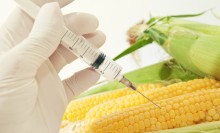
Genetic Engineering

40% Off Sale Celebrates New Non-GMO Logo On Oct 10th!

GMO stands for Genetically Modified Organism. GMO, also known as genetically engineered, bio-engineered, or biotech crop, is a term commonly used to refer to crops that have been genetically altered using gene-splicing technology (See the sidebar, "What Does GMO Mean, and Why Should I Be Concerned?).

Ancient Rice in a Modern World: Biopiracy and Bioengineering

In the course of 8,000 years, innovative Asian farmers have bred over 10,000 varieties of rice, each suited to different growing conditions and tastes. Today, centuries-old practices of traditional rice cultivation are threatened by corporate financial interests and technologies known as "biopiracy" and "bioengineering."

Biopiracy

Are GMOs Safe To Eat?

Since the dawn of time, human beings and animals alike have asked the question every day, “What should I eat?” We need to know not just what tastes good, but what is good for our survival and for our long-term health. We employ our sense of smell, taste, sight and touch, our intelligence, our knowledge of cause and effect and our culture to help us decide what to eat.  Keep Reading →

For more Non-GMO information check out these sites:

Non-GMO Project
The Non-GMO Project is a non-profit collaboration of manufacturers, retailers, processors, distributors, farmers, seed companies and consumers. Members are committed to practical solutions and offer North America’s first consensus-based Standard, third-party Product Verification Program, and uniform Seal for products made following best practices of GMO avoidance.


The Institute for Responsible Technology (IRT)
The Institute for Responsible Technology is a world leader in educating policy makers and the public about genetically modified (GM) foods and crops. Researchers investigate and report the risk of GM foods and impact on health, environment, the economy, and agriculture, as well as the problems associated with current research, regulation, corporate practices, and reporting.


GMO Free Hawaii
Dedicated to protecting Hawaii from genetically engineered organisms through education and action.


GMO-Free Maui
GMO-Free Maui & Hawaii Seed.org are working together to inform and protect Hawaii and its people from the risks posed by genetically engineered organisms. We promote diverse, local, healthy and ecological food and farming practices that support food security for all of the Hawaiian Islands.


Hawaii Seed
A statewide non-profit coalition working on five islands to educate the public about the risks posed by genetically engineered organisms. Hawaii Seed is dedicated to promoting diverse, local, healthy and ecological food and farming that supports real food security for the Hawaiian Islands. It is a comprised of grassroots groups composed of farmers, doctors, scientists, lawyers, concerned citizens, and Native Hawaiians.


World Rainforest Movement
For information about GM trees.


Organic Trade Association
This is the membership-based business association for the organic industry in North America. OTA's mission is to encourage global sustainability through promoting and protecting the growth of diverse organic trade.


Say No to GMOs!
This site offers extensive information on the complex and controversial issue of genetic engineering.


Greenpeace Canada
Greenpeace's Say No to Genetic Engineering webpage.


Genetic Engineering Action Network
A diverse network of grassroots activists, national and community non-governmental organizations (NGOs), farmer and farm advocacy groups, academics and scientists who have come together to work on the myriad of issues surrounding biotechnology.


Friends of the Earth
Friends of the Earth is the U.S. voice of an influential, international network of grassroots groups in 70 countries. Friends of the Earth has for decades been at the forefront of high-profile efforts to create a healthier, just world. (search on genetic engineering)


GE Food Alert
A coalition of seven organizations united in their commitment to testing and labeling genetically engineered food.


True Food Network
A resource that you can come to for information and, most importantly, a place you can come to take action regarding GE foods.


Organic Consumers Association
A grassroots non-profit public interest organization which deals with crucial issues of food safety, industrial agriculture, genetic engineering, corporate accountability, and environmental sustainability. Keep Reading →

GMO Foods Should be Labeled

"We have the Right to Know What is in Our Food"

by Mark Fergusson

One of the most dangerous and least understood experiments with human health the world has ever known is currently underway without your consent—in your household and households across the nation, indeed throughout our entire planet. It is the wholesale contamination of the world's food supply with genetically modified organisms (GMOs).

A GMO is the result of a laboratory process where genes are taken from one species and inserted into another in an attempt to obtain a desired trait or characteristic. GMOs are also known as genetically engineered-, bio-engineered-, biotech crops, or transgenic organisms.

While GMO proponents say their goal is to increase nutritional benefits or productivity, the two main traits that have been added to date are herbicide tolerance and the ability of the plant to produce its own pesticide. These results have no health benefits, only economic benefits to the companies that produce them, at the cost of significant negative consequences

Introduced in 1996, the genetic engineering of plants and animals today looms as one of the greatest and most intractable environmental and health challenges of the 21st Century. With promises of making more and supposedly “better” food, this new technology has invaded our farmlands, grocery stores, and our kitchen pantries by fundamentally altering some of our most important staple food crops. Keep Reading →

GMO Labeling: The Right to Choose

When it comes to food science, I often think of what food will be like in twenty, fifty or even a hundred years. I wonder about the quality of food available for my children, future grandchildren, and great-grandchildren. I question whether that food is going to be good for their health or not. And at the very least, if they will have the right to know what is in the food they consume. Keep Reading →

GMOs: Risky Business

Food labeling laws have come a long way. For the benefit of the consumer, requiring identification of allergens and trans-fats is now mandated by the law. However, biotechnology, the process of genetic engineering that creates genetically modified organisms (GMOs), is a rapidly growing and potentially dangerous technology that has no labeling requirements. Today, many commercial crops are genetically engineered, with soybeans, corn, and canola at the top of the list. The only way to avoid them is to purchase products labeled “organic” or “Non-GMO.” Keep Reading →

Knowing When to Say When

No, this is not an article about drinking and driving. It is about common sense and respect for nature. Big business has for years poisoned our food and water supplies with all sorts of chemical fertilizers and pesticides in the name of “progress.” It was really just a determined few who managed to preserve any meaning to the word “organic.” Keep Reading →

Organic Food: Good for You and the Environment

When we think about consuming the freshest and healthiest food possible, it is important to consider two questions. One – what makes organic food natural? And the other – what impact do your shopping choices have on the environment?

On Organic food

Risks of Genetic Engineering

Down to Earth Position Statement on GMOs

Down to Earth is opposed to the development of products containing GMOs because we believe they pose health and safety risks that far outweigh the purported benefits.

Join Down to Earth's New Customer Rewards Program

Click here for details.

Sign in!

Create your account or login to comment on articles, rate recipes, and interact with the community.